
The Cost of Being Left Behind: Why Businesses Can't Ignore AI
August 26, 2026
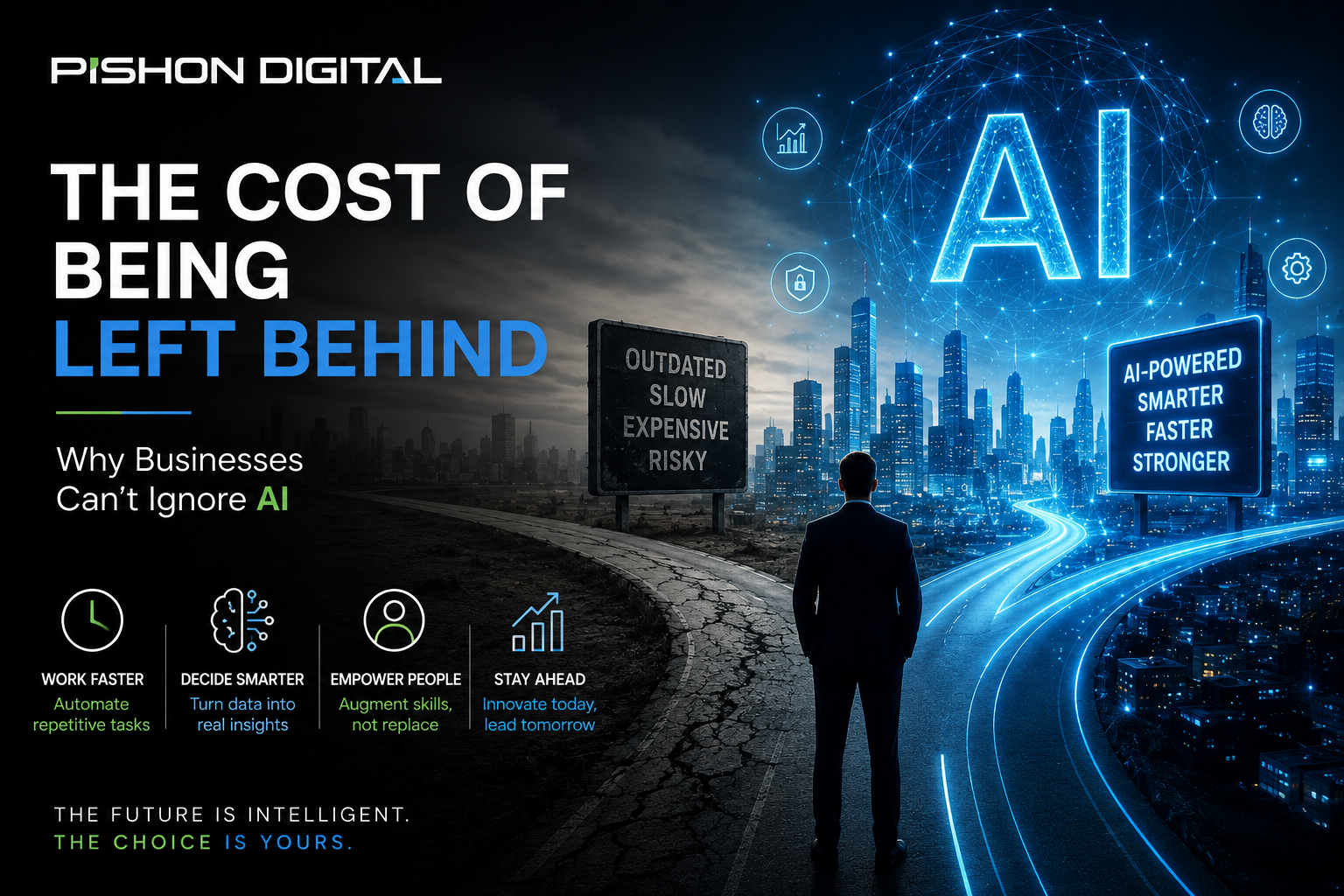
The Cost of Being Left Behind: Why Businesses Can't Ignore AI
Artificial intelligence is no longer a technology waiting for the future.
It is already changing how businesses operate, how employees work, how customers are served and how decisions are made.
For some organisations, AI is an opportunity to become faster, smarter and more competitive.
For others, it is becoming a serious question:
What happens if we do nothing?
The cost of being left behind by AI may not always appear as a large invoice or an obvious loss. It can happen gradually — through slower processes, higher operating costs, missed opportunities, outdated systems and competitors moving faster.
And by the time the difference becomes obvious, catching up may be significantly harder.
AI Is Changing the Competitive Landscape
For years, businesses competed through their people, products, locations, capital and technology.
AI is adding another dimension to that competition: intelligence at scale.
A company can now use AI to analyse thousands of documents, identify patterns in data, automate repetitive tasks, assist employees, monitor risks, generate reports and provide decision-support in a fraction of the time that traditional processes may require.
This doesn't necessarily mean replacing employees. In many cases, it means giving employees better tools. A finance team can spend less time manually processing information. A safety team can identify trends across incidents. A customer service team can respond faster. An executive can receive a clearer picture of what is happening across the organisation. The organisations that learn how to combine human expertise with AI may have a significant advantage over those that don't.
The Real Cost Isn't Buying AI One of the biggest misconceptions about AI is that the main cost is implementing it.
The bigger cost could be not implementing it.
Imagine two companies operating in the same industry.
Company A begins integrating AI into its operations. It automates repetitive processes, trains its employees, improves its data infrastructure and gradually builds AI into its decision-making.
Company B decides to wait.
Six months later, the difference might be small.
Two years later, Company A may have significantly more efficient processes, better internal intelligence and employees who are comfortable working alongside AI.
Company B is now trying to catch up.
The problem isn't simply that Company B lacks AI.
It lacks the experience, data, infrastructure and organisational knowledge that Company A accumulated while experimenting and improving.
That gap can become expensive.
Productivity Is Becoming a Competitive Advantage
Every business wants to do more with less.
AI can help make that possible.
Consider the amount of time organisations spend on repetitive work:
* Reading and sorting documents * Creating reports * Responding to routine questions * Analysing spreadsheets * Searching through large amounts of information * Monitoring operational data * Preparing summaries * Identifying inconsistencies * Moving information between systems
Many of these processes don't necessarily require humans to perform every individual step manually.
AI can assist with them.
When a business saves minutes on thousands of processes, those minutes can become hours, days and eventually significant amounts of organisational capacity.
The competitive advantage isn't necessarily that AI works without people.
It is that people can spend more of their time doing work that actually requires people.
The Workforce Is Changing
AI is also changing what it means to be productive at work.
The question is increasingly moving from:
"Can you do this task?"
to:
"Can you use technology effectively to accomplish this task?"
Employees who understand how to work with AI may be able to produce higher-quality work in less time. This doesn't mean every employee needs to become a programmer or AI researcher. A finance professional doesn't need to build an AI model from scratch. A lawyer doesn't need to become a machine-learning engineer. A mine manager doesn't need to understand every technical detail behind an AI system.
But they increasingly need to understand how AI can be applied to their work.
That is the beginning of AI literacy.
The Data Problem
There is another reason organisations cannot afford to wait.
AI is only as useful as the information surrounding it.
Businesses that spend years collecting, organising and structuring their data will eventually have a stronger foundation for intelligent systems.
Organisations with fragmented, inaccurate or inaccessible data may struggle to take advantage of AI.
This means AI adoption isn't simply about installing a chatbot.
It can require organisations to rethink how they collect, store, protect and use information.
The companies that start building that foundation today may be better positioned tomorrow.
AI Doesn't Have to Replace People
The conversation around AI often focuses on one fear:
"Will AI take our jobs?"
But another question deserves just as much attention:
"Will people who know how to use AI replace people who don't?"
Technology has always changed the nature of work.
The calculator didn't eliminate mathematics.
Computers didn't eliminate offices.
The internet didn't eliminate businesses.
Instead, these technologies changed what people could accomplish.
AI is likely to do the same — but potentially at a much larger scale.
The opportunity isn't necessarily to replace people.
It is to augment people.
The best organisations may be the ones that give their employees powerful tools while keeping human judgement, creativity, accountability and experience at the centre.
The Biggest Risk May Be Doing Nothing
AI adoption doesn't have to happen overnight.
A business doesn't need to transform every department tomorrow.
But doing nothing is also a decision.
Organisations can start small.
Identify repetitive processes.
Find areas where employees spend too much time searching for information.
Look for decisions that depend on large amounts of data.
Automate simple workflows.
Introduce AI assistants.
Train employees.
Improve data systems.
Measure the results.
Then expand.
The goal isn't to use AI everywhere.
The goal is to use AI where it creates real value.
The Future Will Belong to Adaptable Organisations
Nobody knows exactly what AI will look like five or ten years from now.
But one thing is becoming increasingly clear:
The organisations that are willing to learn, experiment and adapt will have an advantage. Being early doesn't guarantee success. But refusing to adapt can create a disadvantage that becomes increasingly difficult to reverse.
The cost of being left behind isn't necessarily one dramatic event.
It is the accumulation of small disadvantages:
Slower decisions.
Higher costs.
Less productive teams.
Outdated processes.
Missed opportunities.
Competitors moving faster.
And eventually, the uncomfortable realisation that the technology you once considered optional has become essential.
The Question Businesses Should Be Asking
The question shouldn't simply be:
"Should we use AI?"
A better question is:
"Where can AI make our organisation better?"
That question opens the door to practical transformation.
AI can help businesses become more efficient.
It can help employees become more productive.
It can help leaders make better-informed decisions.
It can help organisations identify risks earlier.
And it can create entirely new products and services that weren't previously possible.
At Pishon Digital, we believe technology should solve real problems — not simply follow trends.
The future of AI isn't about replacing everything that exists.
It is about building better ways of working. And the organisations that start preparing today may be the ones defining tomorrow. The future is moving. The real cost is standing still.
Pishon Digital
Building intelligent software solutions that solve real problems and help organisations prepare for what's next.